Tariff Fraud Calculator
Understanding how we calculate the estimated value of tariff fraud and fraudulent trade
Calculation Methodology
The Scope of Customs Fraud: A $208 Billion Gap (2018–2025)
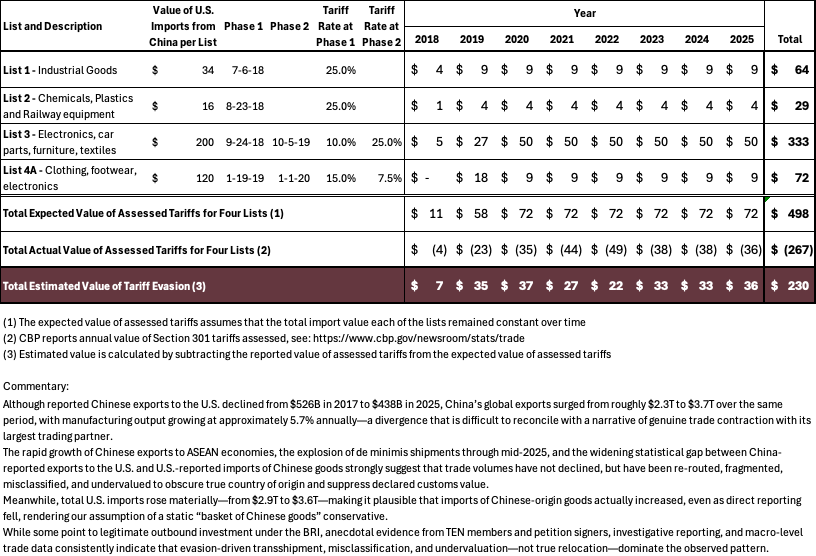
If the value and composition of U.S. imports from China had remained constant after 2018, U.S. Customs and Border Protection (CBP) should have collected approximately $498 billion in Section 301 tariffs between 2018 and 2025, based on announced tariff rates applied to roughly $370–$380 billion of covered Chinese imports per year.Over the same period, CBP reports assessing only about $267 billion in Section 301 duties—implying an estimated $208 billion shortfall in tariffs that were legally owed but not collected.EnforcementNOW recognizes that some U.S.–China trade was legitimately restructured, including production shifts to third countries involving substantial transformation into goods that no longer qualify as Chinese-origin. However, China’s own export data point to a different conclusion at the aggregate level. Between 2018 and 2025, China’s total exports rose from roughly $2.3 trillion to $3.77 trillion, an increase of more than 60 percent.Given that the United States remains one of China’s largest export markets, it is highly implausible that China could sustain this growth without maintaining—or expanding—the effective flow of goods into the U.S. The more credible explanation is that a substantial share of this trade never truly exited China in terms of value creation, but instead was routed around U.S. tariffs through misclassification, false origin claims, undervaluation, transshipment, and related forms of customs fraud that obscure the true source and value of Chinese goods.EnforcementNOW therefore uses the resulting $208 billion gap as a conservative proxy for the scale of customs fraud associated with Section 301 tariffs during 2018–2025—and as a baseline measure of the revenue loss and deterrence failure resulting from inadequate enforcement.This estimate is limited to Section 301 duties and does not account for additional antidumping and countervailing duties, Section 232 tariffs, or other trade remedies and arrangements that would further increase the potential magnitude of loss.
Key Assumptions & Data Sources
Fixed Baseline
Section 301 tariff-eligible imports maintained at ~$370B to provide consistent measurement framework
Evasion Methods
Accounts for undervaluation, misclassification, and transshipment through third countries
Read the StudyData Sources
CBP Section 301 Assessment Data, US Census Bureau U.S. Trade Deficit Data and U.S. Import Data, Goldman Sachs, CPA De Minimis Analysis
Time Period
Calculations cover January 2018 through December 2025, coinciding with Section 301 implementation
Important Limitations & Disclaimers
Estimation Methodology: These figures represent estimates based on available trade data and observed patterns. Actual fraud amounts may vary due to the covert nature of these activities.
Data Limitations: Trade fraud is deliberately concealed, making precise measurement challenging. Our methodology provides a reasonable approximation based on observable trade flow anomalies.
Evolving Tactics: Fraud methods continuously evolve, and our calculations may not capture all emerging schemes or their full impact.
Policy Context: These estimates are intended to inform policy discussions and should be considered alongside other economic and enforcement data.