Trade Crime
Study Guide / Training Module
Trade crime is the deliberate, systematic abuse of U.S. trade laws to gain unlawful competitive advantage. Because it hides inside routine, paper-driven commerce, it scales easily and often goes unpunished. At scale, this becomes more than a compliance problem. It becomes a strategic vulnerability for the United States.
This Study Guide gives current and future policymakers the foundation to understand modern trade crime: how it works, why the current system struggles to stop it, and how to think clearly about reform.
What You'll Learn
This Study Guide begins with first principles before moving into historical case studies, contemporary policy debates, and detailed policy debriefs. By the end, you will be able to:
- Identify the four main forms of customs fraud: transshipment, undervaluation, misclassification, and smuggling.
- Explain why the Section 301 China tariff-collection gap reveals the scale of the problem.
- Understand how America's import verification system was weakened over time.
- Diagnose the enforcement gap through two questions: how likely is detection, and how certain are consequences when fraud is detected?
- Evaluate the four main reform categories: agency accountability, loophole closure, enforcement tools, and transparency.
This Study Guide was created in partnership with the Alliance for Trade EnforcementNOW, utilizing their interactive and continuously-updated online resource at enforcementnow.com.
The six videos are separate viewing (~50 min) and optional — not counted here.
Part I: What Is It?

Trade Crime 101
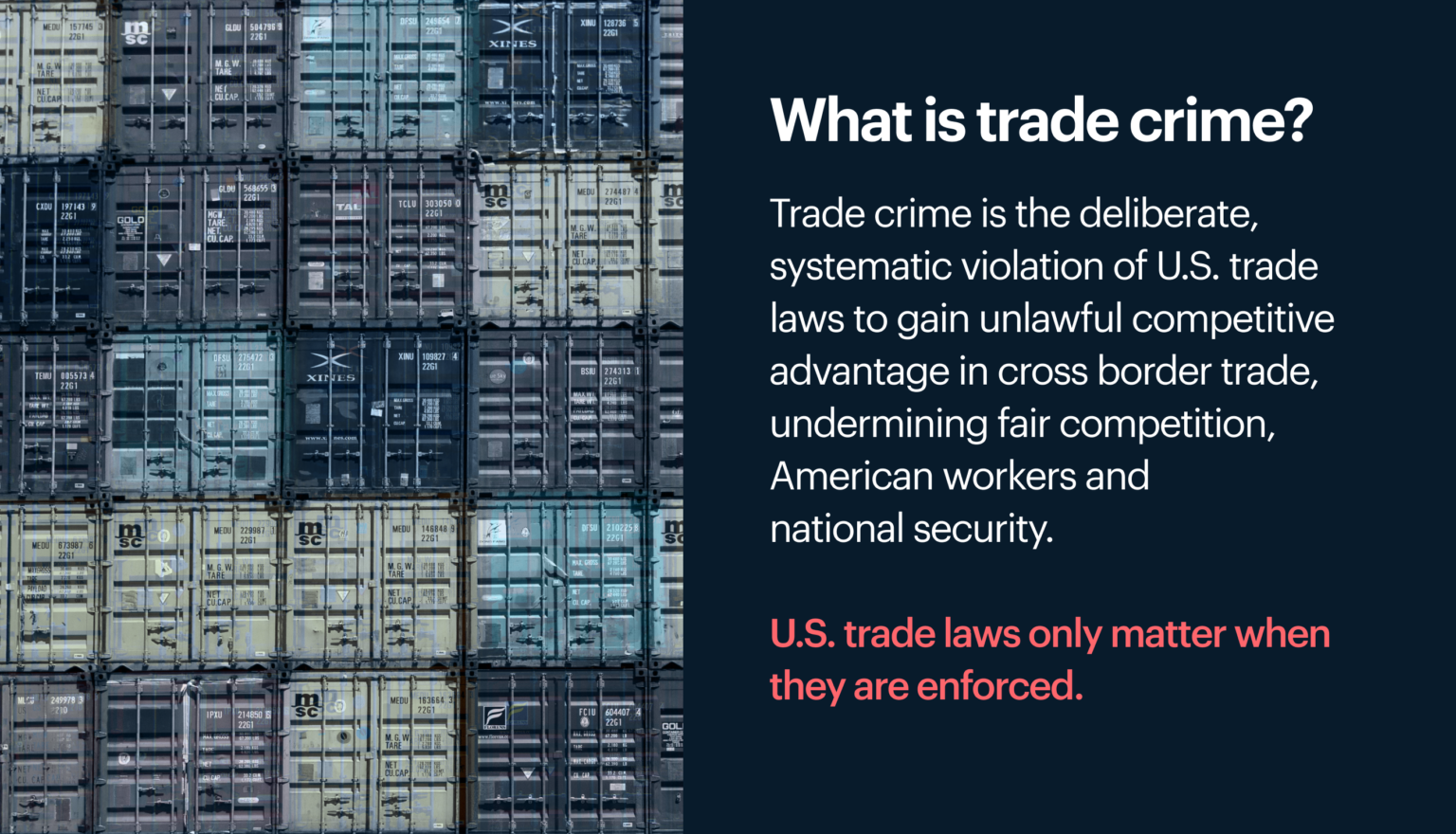
This is economic warfare. U.S. trade laws only matter when they are enforced. “Trade crime is the deliberate, systematic violation of U.S. trade laws to gain unlawful competitive advantage in cross-border trade — undermining fair competition, American workers, and national security.”
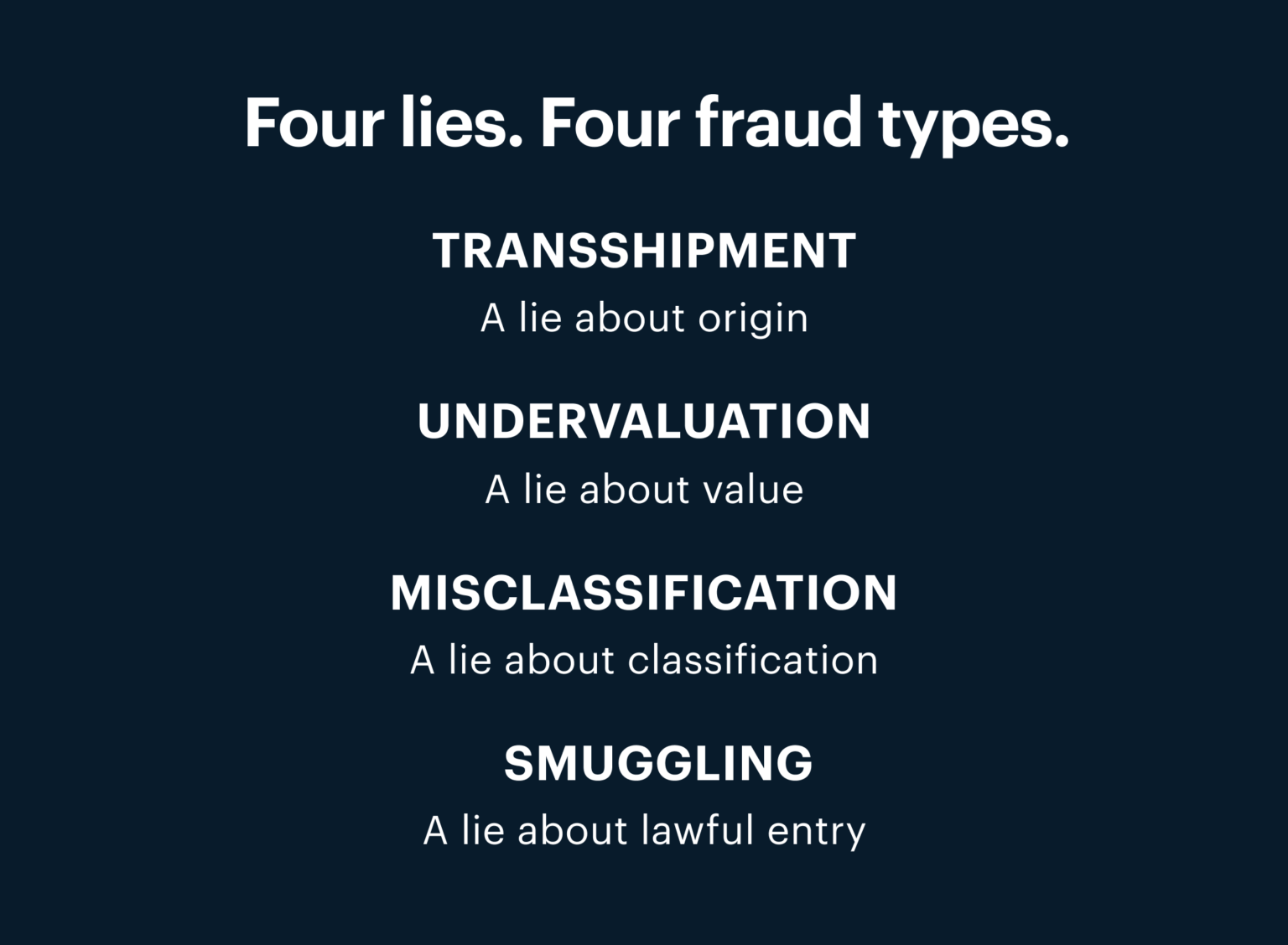
Four Primary Categories of Fraud
(1) Customs Fraud: The deliberate evasion of U.S. customs duties or import restrictions through false origin, false value, false classification, or unlawful concealment.
- Transshipment. Routing goods through third countries to disguise origin and evade tariffs.
- Example: Tens of millions of dollars of Chinese-made quartz countertops routed through Malaysia and entered as non-Chinese — avoiding roughly 340% duties while paying about 27% in ordinary duties.
- Undervaluation. Declaring goods at a fraction of their real value to reduce duties.
- Example: A $200,000 shipment of Chinese apparel entered with a false invoice showing $50,000, incurring duty on only 25% of the true value.
- Misclassification. Using incorrect HTS codes to qualify for lower duty rates.
- Example: Chinese high-grade aluminum subject to 400% duties enters the U.S. as “pallets” — claiming a finished-merchandise exclusion at a 2.5% rate.
- Smuggling. Bringing goods into the U.S. contrary to law by hiding them, omitting them from customs paperwork, or otherwise preventing Customs from seeing what is actually entering.
- Example: Counterfeit goods are hidden inside a container and left off the customs paperwork, so Customs is not told what is actually entering the country.
(2) Intellectual Property Theft: The illicit acquisition of protected know-how, through forced IP-sharing imposed on U.S. companies operating in China, state-sponsored cyber theft, or blatant appropriation by competitors. U.S. losses from Chinese IP theft alone run into the hundreds of billions per year.
(3) Forced Labor: Work exacted under coercion through threat, debt, or restriction of movement, prohibited in U.S. supply chains under the Uyghur Forced Labor Prevention Act and Section 307 of the Tariff Act of 1930. Enforcement depends on traceability that most global supply chains were never built to provide.
This guide focuses on customs fraud as a matter of enforcement design. IP theft and forced labor are equally serious but are not covered in this module.
Study Questions
- How do transshipment, undervaluation, misclassification, and smuggling each work—and why can each be difficult to detect through routine customs review?
Check your thinking
A strong answer would address
- Transshipment — goods are routed through a third country so the entry paperwork shows a non-China origin; routine review sees a legitimate intermediate country, not the true source.
- Undervaluation — a lower value than was actually paid is declared, shrinking the duty owed; review largely relies on the importer’s declared value, so an understated price passes.
- Misclassification — goods are entered under a tariff code that carries a lower or no duty; the entry looks ordinary unless the specific product is examined against the code.
- Smuggling — the record is defeated directly through concealment or false documentation; it is built to beat inspection.
- The common thread — each corrupts a different part of the declaration (origin, value, classification, or the record itself), and routine review begins by trusting the importer’s own filing.
- What evidence distinguishes deliberate, systematic trade fraud from ordinary compliance errors or legitimate disagreements over classification, valuation, or country of origin?
Check your thinking
A strong answer would address
- It is systematic and repeated, not an isolated mistake — the module defines trade crime as deliberate, systematic abuse, which separates it from a one-off error.
- It is structured to deceive — organized to make the paperwork misstate origin, value, or classification, rather than an honest disagreement about a close call.
- Intent and knowledge — the actor knows the declaration is false and does it to gain an unlawful advantage, versus a good-faith reading of an ambiguous rule.
- A legitimate dispute looks different — it is transparent about the facts and argues over how the rule applies; fraud hides the facts themselves.
Part II: Scope and Impact
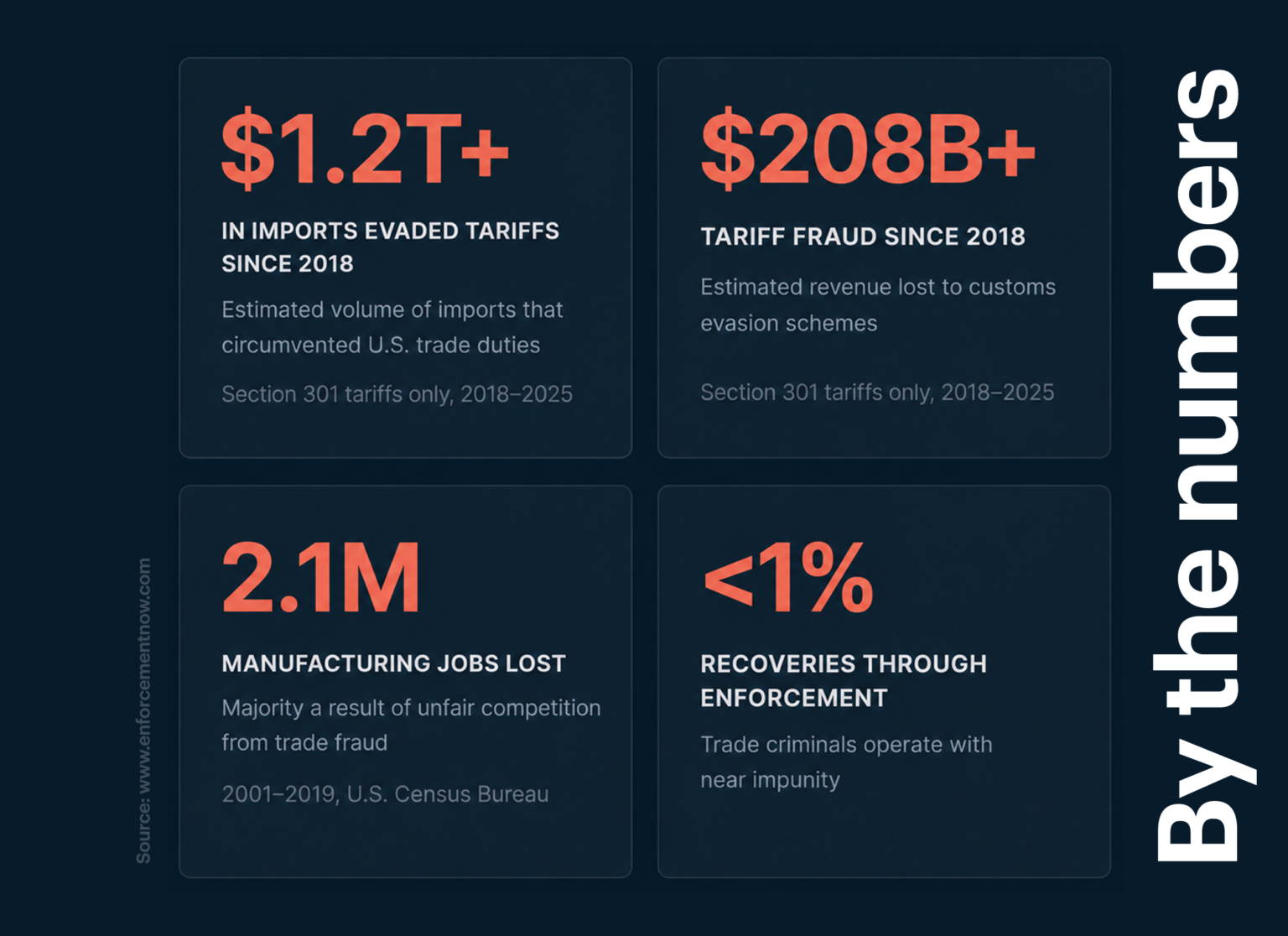
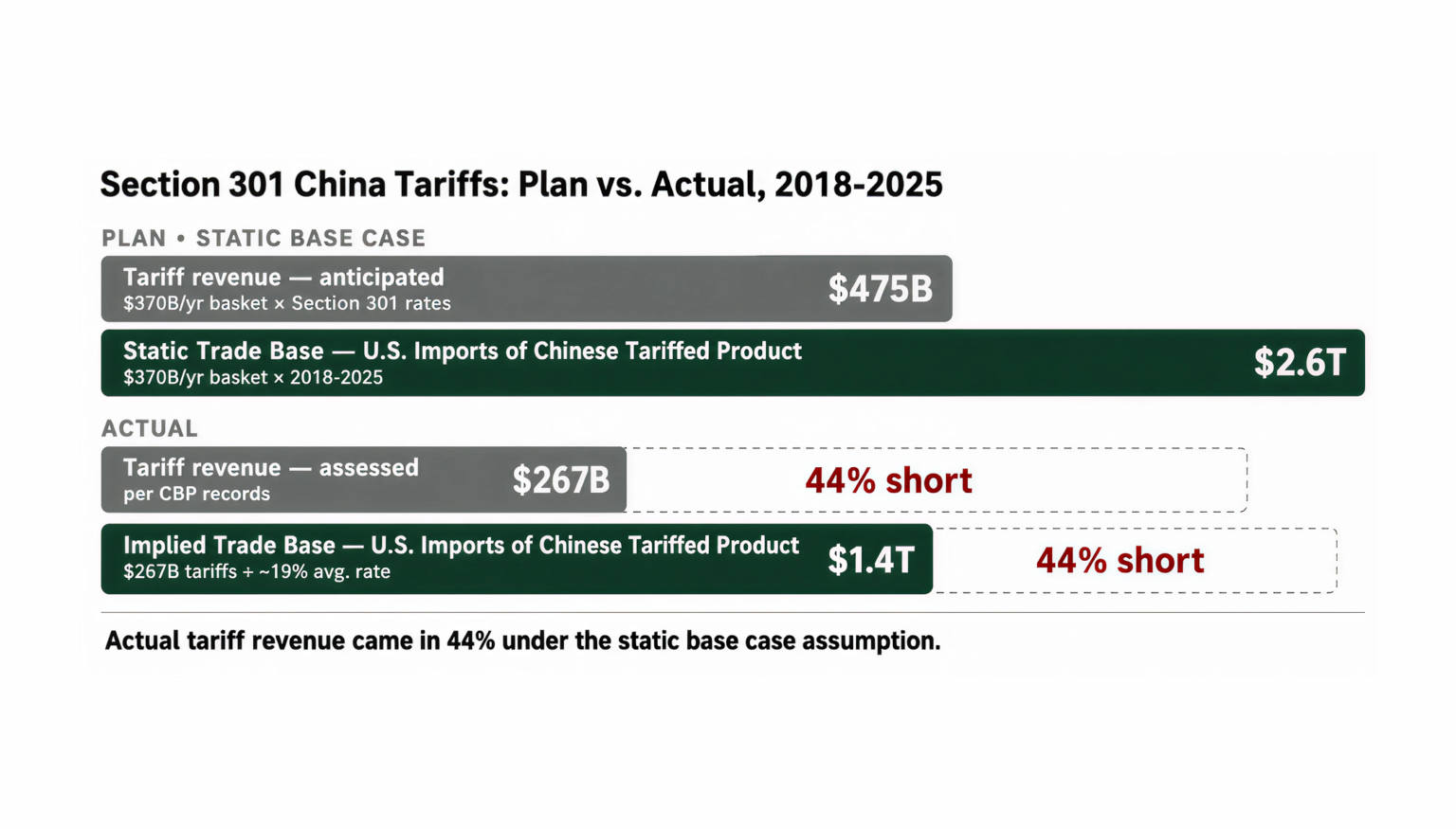
The Section 301 China tariffs give us the clearest available test of tariff evasion because the basic math is straightforward. The China 301 tariffs applied to one country, covered four defined lists of goods, and used consistent published tariff rates. That allowed EnforcementNOW to estimate what CBP should have collected if the original tariffed trade base had continued to enter honestly — and then compare that estimate to what CBP actually collected.
The policy was supposed to do two things: collect significant revenue and level the playing field. It did neither at the scale intended.
What Doesn't Explain the Gap
The exact dollar value of evasion cannot be measured precisely. But the gap between the $70 billion annual benchmark and actual collections still has to be explained. The main lawful explanations do not account for it.
Did Americans stop importing these goods? No. U.S. global imports of the listed goods grew 34% between 2017 and 2025.
Did production leave China en masse? No. Some production moved, but not at the scale required to replace hundreds of billions of dollars in tariffed imports across thousands of product categories in just a few years. Industrial supply chains do not move that fast, especially where qualified capacity, tooling, labor, certification, and cost structure all have to be rebuilt. Nor did Chinese production disappear. Manufacturing in China remained stable after the tariffs were imposed, and in some categories increased.
Did imports come in under the de minimis exemption? Partially, but it's complicated. The $800 duty-free channel was exploited. Shipments rose from roughly 134 million in 2015 to 1.36 billion in 2024 — a tenfold increase. The flaw was structural: the rule capped declared value at $800, not weight, quantity, or aggregate import volume. That made it possible to move large volumes of Chinese goods through a channel never designed for mass commercial trade. It was an abused loophole that has since been closed.
That leaves the harder explanation: the goods kept moving between China and the United States, but the trade records stopped reflecting reality. The gap is explained by the methods bad actors use to make customs paperwork lie: false origin, false value, false classification, and unlawful entry.
Evidence by Evasion Mechanism
Transshipment. Seven years after the Section 301 tariffs were imposed, the trade map had changed dramatically. As of 2024, China was exporting more than $150 billion more per year to Vietnam, Thailand, and Cambodia than before the tariffs took effect in 2018. Those same three countries were then exporting nearly the same additional amount per year to the United States, often in similar product categories and on the same timeline. The point is not that production neatly moved out of China. Chinese goods appear to have changed route. The scale, timing, and product overlap all point in the same direction: industrial-scale illegal transshipment.

Undervaluation. When goods move from China to the U.S., both governments record the transaction. For years the relationship was stable: U.S. import records showed about $70 billion more than China's export records. After the Section 301 tariffs, that relationship flipped. By 2024, U.S. import records showed about $85 billion less than China's export records — a swing of roughly $155 billion. Federal Reserve Bank of New York research identified more than $100 billion in “missing imports,” attributable to China. That is what undervaluation looks like: goods enter the country, but at artificially reduced declared values, lowering the duties paid.

Misclassification. More difficult to detect in aggregate data, but it reveals itself through major enforcement cases. The two largest trade-fraud cases in U.S. history were both rooted in misclassification. In the China Zhongwang/Perfectus aluminum case, the criminal restitution order was $1.83 billion; the related civil False Claims Act settlement later resolved for $549.5 million. In the Ford Transit Connect case, the government's claim was valued at roughly $1.3 billion before Ford settled for $365 million in 2024. Changing the product category can mitigate hundreds of millions — or billions — in tariff liability while leaving little obvious signal in headline trade data.
Smuggling. The hardest form to measure because it is designed to defeat the customs record itself. In a 2025 Los Angeles case, DOJ charged nine defendants in a 15-count indictment involving counterfeit and illegal goods shipped from China through the Ports of Los Angeles and Long Beach. The alleged scheme used logistics companies, warehouses, and truck drivers to remove contraband from containers selected for inspection, replace it with filler cargo, and reseal with counterfeit customs seals. Investigators seized more than $130 million in contraband and alleged the organization was responsible for at least $200 million in smuggled goods.
Bottom line: The precise dollar value of trade fraud is unknowable. The scale is not.
Study Questions
- Why may Section 301 provide a particularly useful lens for understanding the potential scale of tariff evasion and trade fraud?
Check your thinking
A strong answer would address
- Section 301 is unusually measurable: it applies to one country, a defined set of goods (the four lists), at consistent published rates — so you can estimate what CBP should have collected and compare it to what it actually collected.
- That clean structure turns the collection gap into an estimate of the scale of evasion — something most trade rules are too diffuse to give you.
- The gap is not explained by innocent causes — Americans did not stop importing, production did not leave China en masse, and de minimis accounts for only part — which points to evasion as the remaining explanation.
- So 301 works as a lens because the size of the unexplained shortfall lets you bound the potential scale of fraud.
- Because successful trade fraud can distort the data used to measure it, how should policymakers weigh economic studies, enforcement cases, industry evidence, and aggregate trade data when assessing its scale and impact?
Check your thinking
Open-ended — synthesize widely. Threads worth pulling
- The trap the question names: successful fraud corrupts the very data used to measure it, so no single source is authoritative.
- Play the sources against each other — aggregate data (broad, but understated by the fraud), economic studies (scale and patterns, but modeled), enforcement cases (mechanism, but selective), industry evidence (real-time, but interested) — each has a different blind spot.
- The deeper problem: reasoning when the measuring instrument is compromised by the thing being measured — how do you bound an unknowable with partial, biased evidence?
- Weigh convergence versus divergence: what do you conclude when independent sources agree, and how much weight when they do not?
There is no single right answer — build a defensible method for weighing compromised evidence.
Part III: How We Got Here
The United States once had a customs system built around verification: what entered the country, where it came from, and what it was worth. It was not destroyed all at once. It was undone piece by piece over fifty years, each cut defended as modernization, simplification, or alignment with global trading norms. The result was a long, slow unraveling of customs verification — dressed up as progress.
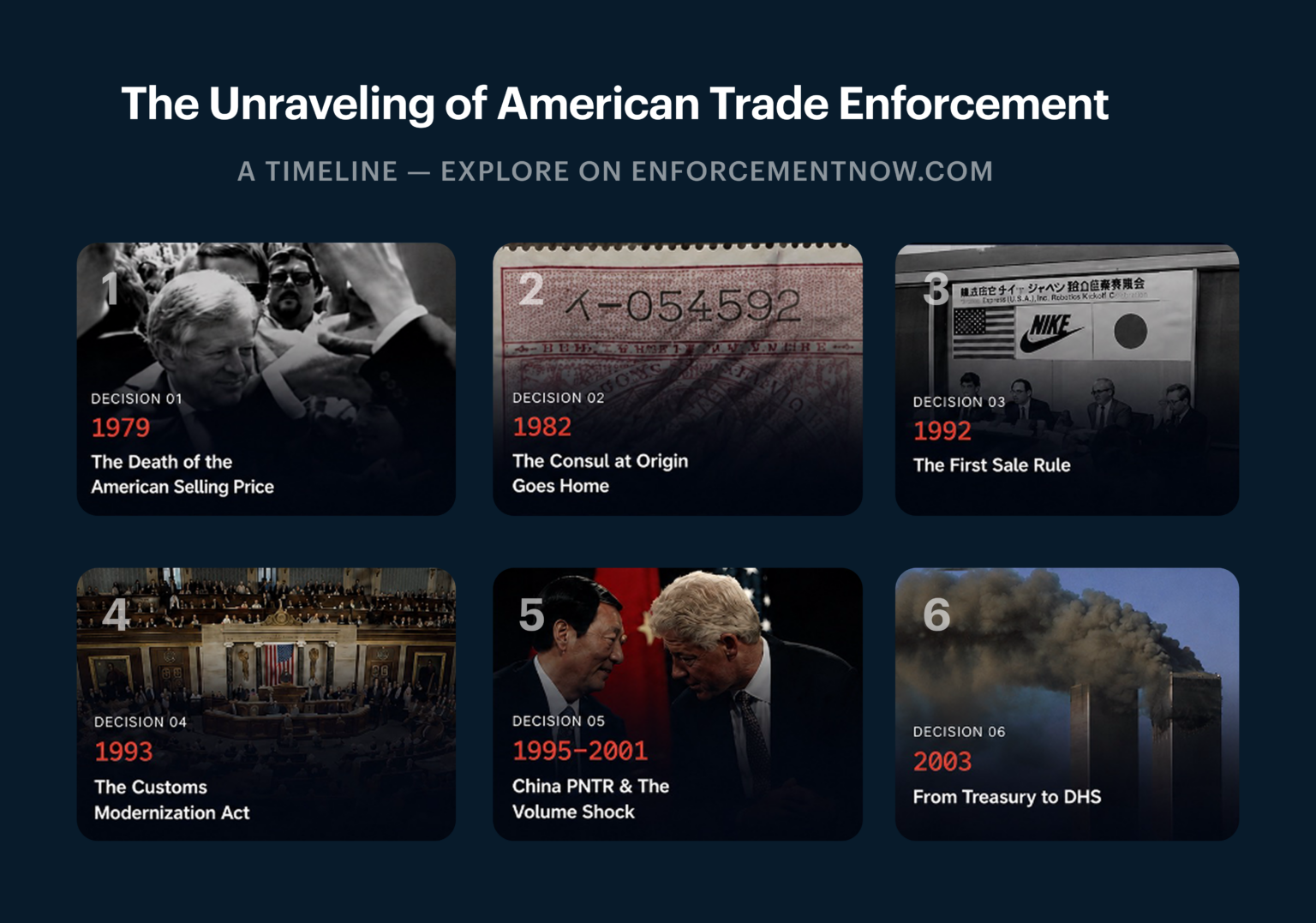
What the Timeline Shows
Verification was surrendered. In 1979, the Trade Agreements Act ended the American Selling Price system and made transaction value the foundation of customs valuation — shifting toward importer-declared prices. In 1982, Congress ended consular invoice verification abroad. In 1992, the Federal Circuit's First Sale Rule allowed qualifying importers to use an earlier sale in a multi-tier supply chain as the dutiable value. In 1993, the Customs Modernization Act completed the inversion: the importer became the first-line assessor of his own duties, with Customs auditing after the fact.
Then came the volume shock. By the time China's PNTR and WTO accession arrived in 2000–2001, the architecture of customs verification had already been weakened. The fivefold surge in Chinese imports that followed did not cause the failure — it revealed it. China walked through doors whose hinges we had already removed. For a generation, U.S. policy and business leaders assumed integration would moderate Beijing. Beijing accepted the access, rejected the premise, and used the opening to advance its own national interest.
Then Customs' mission changed. In 2003, the agency was moved from Treasury — its institutional home since 1789 — into the new Department of Homeland Security, where customs enforcement became part of a broader homeland-security mandate rather than a revenue-centered one.
When Section 232 and Section 301 tariffs restored meaningful duties on large categories of imports in 2018, the reward for cheating multiplied overnight. But the enforcement architecture needed to meet that risk had never been rebuilt. The reform agenda in Part VI is not an attempt to invent something new. It is an attempt to rebuild what was lost.
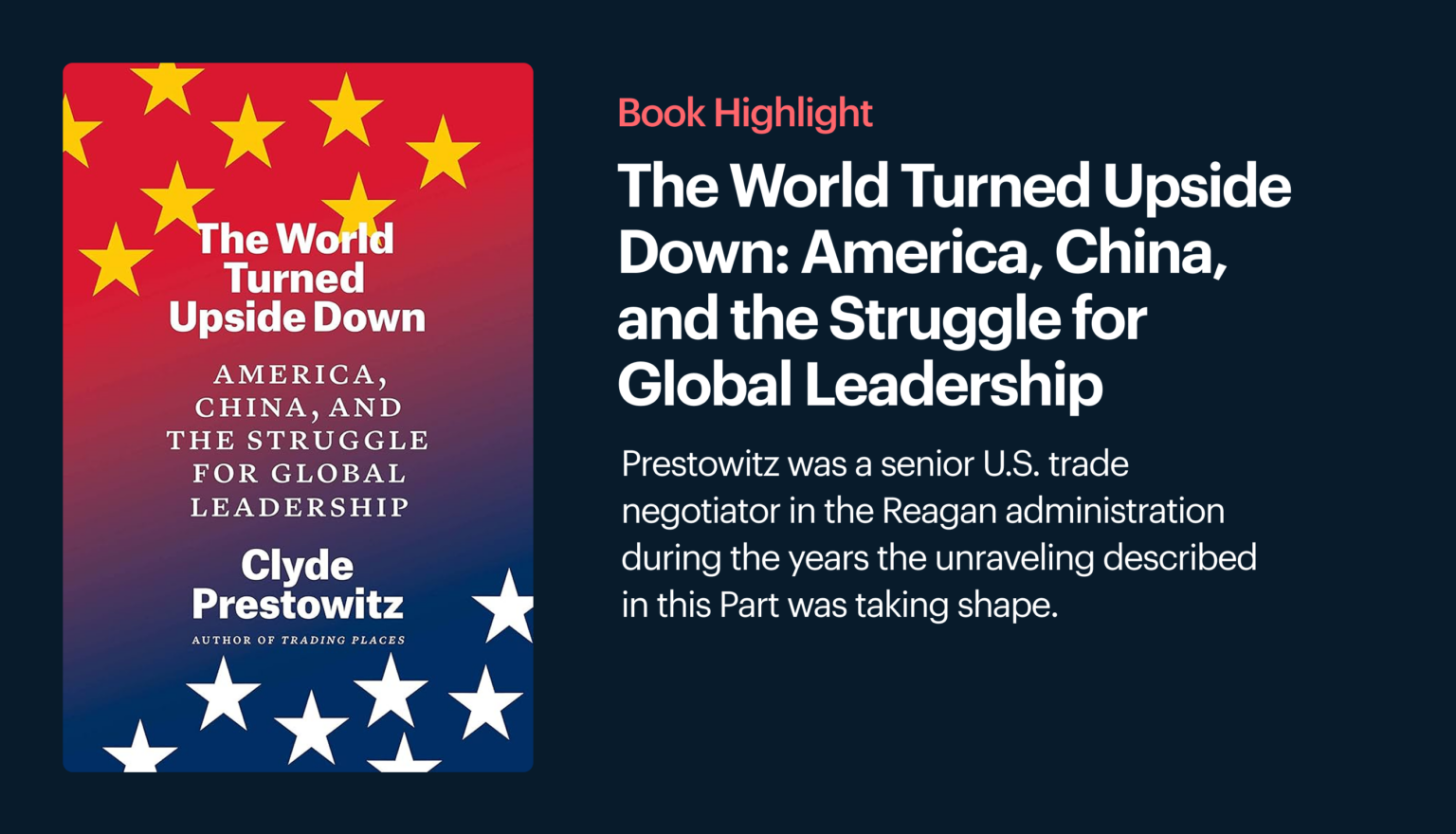
The World Turned Upside Down
Author Clyde Prestowitz's career has been one long argument that the post-1979 trade settlement was a strategic miscalculation — hollowing out the verification infrastructure of American commerce while assuming that other states would reciprocate openness in kind.
Why read: Prestowitz writes with the authority of a practitioner who watched the dismantling happen from the inside. He is not a polemicist; he is a former government official who concluded, slowly and reluctantly, that the consensus he had worked under was incorrect.
Study Questions
- What benefits was each major customs reform intended to achieve, and what effect did it have on the government’s ability to verify imports and enforce trade laws?
Check your thinking
A strong answer would address
- The intended benefit was the same each time, per the text: each cut was defended as modernization, simplification, or alignment with global trading norms.
- 1979 (Trade Agreements Act) — ended the American Selling Price system and made transaction value the basis of valuation, shifting toward importer-declared prices.
- 1982 — ended consular invoice verification abroad.
- 1992 (First Sale Rule) — let qualifying importers use an earlier sale in a multi-tier chain as the dutiable value.
- 1993 (Customs Modernization Act) — completed the inversion: the importer became the first-line assessor of his own duties, with Customs auditing only after the fact.
- The effect, in the text’s own words: verification was surrendered — the system moved from government checking to importer self-reporting.
- If speed and modernization remain legitimate goals, what capabilities must a modern customs system include to preserve efficiency without relying excessively on importer self-reporting?
Check your thinking
A strong answer would address
- The commentary frames the loss as verification itself — so what a modern system must add back is the ability to verify the declaration independently, rather than rest on the importer’s self-report.
- The 1993 model left Customs auditing only after the fact — so that after-the-fact check has to actually function, not be nominal, for self-assessment to be safe.
- The text is explicit that the goal is not to invent something new but “to rebuild what was lost” — the verification capacity surrendered between 1979 and 1993 — while keeping the efficiency those reforms gained.
Part IV: Enforcement
Straightforward administrative customs cases can be handled entirely by CBP. But if a matter involves AD/CVD evasion, suspected fraud, unpaid penalties, or litigation, the case becomes a relay across agencies. CBP may start the process, but Commerce, ITC, HSI, DOJ, Treasury, and multiple courts may each control part of the outcome.
CBP's entry reviews, post-summary work, and audits recover substantial duty revenue each year. That is the routine compliance machinery, and it matters. Deliberate evasion runs on a harder track. CBP can issue penalties, EAPA can identify AD/CVD evasion, and DOJ can pursue civil or criminal cases. But this pathway rarely produces timely, visible consequences. Public data on penalties actually collected is limited, formal DOJ actions are rare, and cases that reach charging often take years to resolve.
The result is a system that works reasonably well when importers make mistakes and cooperate, but becomes slow and fragmented when the importer refuses to cooperate or the facts suggest fraud. Two questions reveal the problem: how likely is detection, and how certain are consequences if fraud is detected? For deliberate fraud, the system struggles on both. EnforcementNOW's trade-fraud case tracker indicates that the average time from first violation to case closure is 8.3 years.
That 8.3-year average breaks into two windows. EnforcementNOW's review of DOJ-closed cases over the last three years found the underlying fraud ran an average of 5.6 years before it stopped — years in which duties went unpaid and lawful competitors lost share. The remaining 2.7 years were enforcement lag: investigation, referral, litigation, and settlement after the conduct had already ended.
The following two cases show how the system breaks in practice: one where the target sits offshore and disappears, and one where the target is visible, but the government still moves too slowly to stop the harm.
Case Study: Charlotte Pipe and Foundry

Charlotte Pipe and Foundry. North Carolina. 1,800 employees, seven U.S. plants. Founded 1901.
In 2017–18, Charlotte Pipe and the Cast Iron Soil Pipe Institute won AD/CVD orders against Chinese cast iron pipe and fittings — duties reaching 345% on pipe and 494% on fittings. Chinese producers immediately switched to transshipping through Malaysia and Cambodia. Because EAPA does not allow CBP to initiate investigations on its own, Charlotte Pipe filed all ten transshipment allegations itself over the next seven years. When investigators went to the alleged Malaysian and Cambodian foundries, they found, in Muller's words, “an empty warehouse and a bus stop, but no foundries.” Each enforcement action triggered the dissolution of one shell company and the appearance of another.
Estimated duties evaded in this example exceed $44 million. Chinese transshippers now openly advertise the service. In July 2025, Charlotte Pipe's VP Bradford Muller testified before the House Judiciary Subcommittee in support of the Fighting Trade Cheats Act and a $20 million DOJ trade-fraud crime unit.
Case Study: Plews & Edelmann
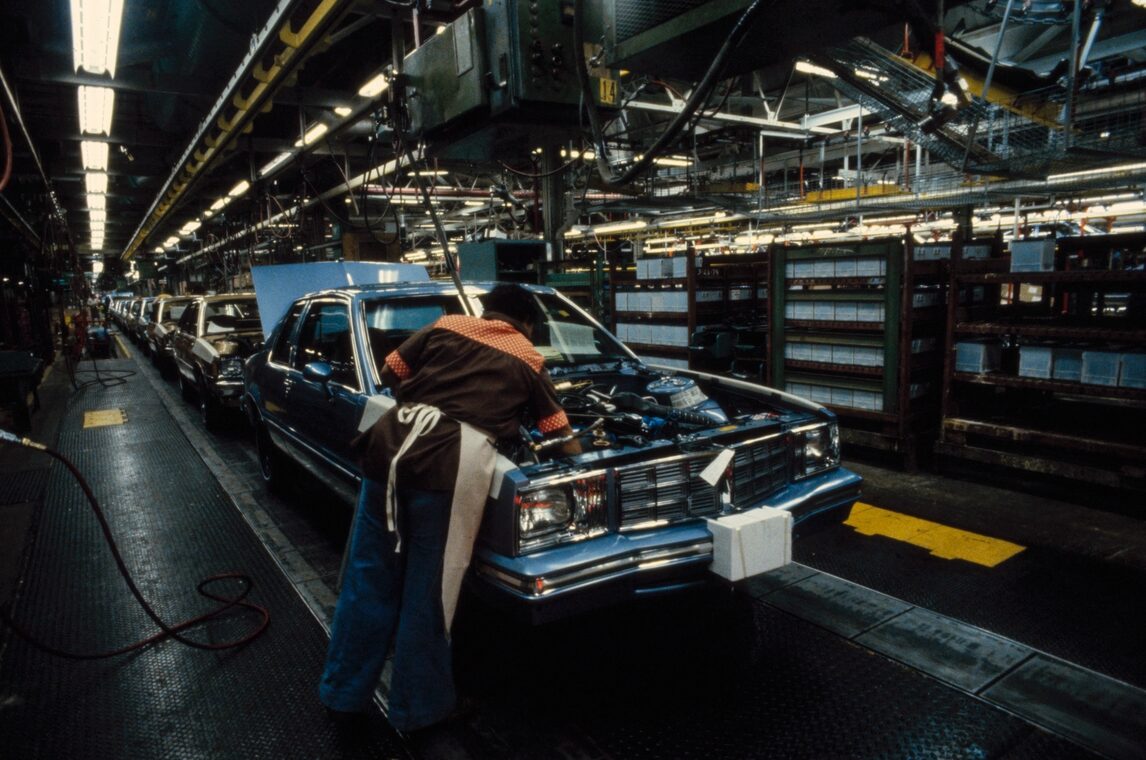
Plews & Edelmann. Dixon, Illinois. 117 years old. Automotive aftermarket manufacturer.
In 2018, Section 301 tariffs imposed a 25% duty on Chinese auto parts. Plews expected its Chinese competitor, Qingdao Sunsong, to raise prices. Sunsong didn't — it shifted the declared origin of its power steering hoses from China to Thailand. Its supply base and equipment hadn't moved, and Sunsong's own filings said it accelerated Thai processing to reduce tariff costs. Independent analysis later found that Thai processing added only 4% to 8% of value per part — far below the threshold required to qualify as “substantial transformation,” a necessary precondition for a change of country of origin.
Beginning in 2021, Plews pursued every available channel: a False Claims Act filing, a CBP e-allegation, engagement with DOJ's trade-fraud apparatus, and congressional outreach. In 2023, members of the House Select Committee on the CCP reviewed the matter and wrote to DHS describing Sunsong's conduct as “a case of blatant trade fraud” with “a catastrophic impact on American manufacturers.” By then, Plews had sold off a division and laid off roughly 50 workers — about a quarter of its U.S. workforce.
A DHS raid on Sunsong's Ohio facility followed in January 2024, and a DOJ investigation remains ongoing as of May 2026. Sunsong continues to operate in Ohio undeterred.
In both cases, these American companies did what the system asked. In both cases, the illegal trade flows continued. The problem is not the absence of reporting tools. It is the absence of timely consequences. Companies identify the fraud, report the fraud, and still watch the damage continue.
The Reporting Tools and Their Limits
| Tool | Who can file | Real-world limitation |
|---|---|---|
| e-Allegations Program | Anyone | No transparency. OIG audits document failures. No measurable outcomes reported. |
| EAPA (Enforce and Protect Act) | Domestic industry | Can disrupt one evasion channel, but offshore NRIs/IORs can dissolve and reappear. Public reporting identifies evasion and duties at issue, not dollars actually collected. |
| False Claims Act (qui tam) | Private relators | Cases take years. Assistant U.S. Attorney offices lack capacity. Charges often knocked down to a “speeding ticket.” |
| DOJ Criminal Whistleblower | Whistleblowers | Too new to assess. Faces the same resource constraints and limitations as the rest of the system. |
These tools were supposed to turn industry intelligence into enforcement action. But when tips disappear into opaque processes, targets operate offshore, cases take years, and investigators and prosecutors lack capacity, tariff policy is hollowed out in practice. Detection remains uncertain; consequences arrive slowly, inconsistently, or not at all.
Study Questions
- Why do existing reporting and enforcement mechanisms often fail to impose accountability on offshore Non-Resident Importers? Where does the enforcement chain break down?
Check your thinking
A strong answer would address
- The failure is not detection but collectibility — an offshore Non-Resident Importer has no people or assets in the U.S. to hold accountable.
- Every tool shares this blind spot: e-Allegations, EAPA, the False Claims Act, and the DOJ criminal channel can flag evasion but cannot reach an actor who dissolves and reappears.
- EAPA may close one channel, but the shell entity dissolves and a new one takes its place — the “whack-a-mole” pattern.
- Even when a case proceeds it runs years, and penalties often go uncollected or are reduced.
- The break is structural: the system assumes a resident, reachable importer of record — so the fix is changing who may serve as importer of record.
- Charlotte Pipe and Plews illustrate different enforcement failures: offshore actors that can disappear before accountability attaches, and identifiable actors that remain in the market while proceedings continue. What does this contrast reveal about the difference between detecting trade crime and deterring it?
Check your thinking
A strong answer would address
- Detection is not deterrence: both firms detected and reported the fraud, and the illegal flows continued anyway.
- Charlotte Pipe shows the offshore problem — the target vanishes (“an empty warehouse and a bus stop, but no foundries”) before accountability can attach.
- Plews shows the speed problem — the target is visible and still operating, yet the case crawls; justice delayed is justice denied.
- Deterrence needs what detection cannot supply: a reachable, collectible defendant and timely consequences.
- The takeaway: reporting tools produce intelligence, not deterrence — deterrence requires consequences that are both certain and fast.
Part V: China

The trade-enforcement problem is not exclusive to China. However, China is the critical stress test for our weakened system. Its scale, state-directed industrial model, and ability to weaponize customs evasion turn enforcement gaps into national strategic vulnerabilities.
Case Study: Solar Panel Industry
Solar is the clearest example. In 2004, Chinese firms produced less than 2% of the world's solar cells. By 2024, China dominated every major stage of the solar supply chain — polysilicon, wafers, cells, and modules. This was not simply private firms succeeding in a neutral market. It reflected a state-directed industrial strategy built on subsidies, cheap credit, industrial coordination, forced scale, and long-term policy support. The CCP's Made in China 2025 program later made that ambition explicit.
That distinction matters because enforcement tools built for ordinary trade disputes are not designed for state-directed industrial systems that can reorganize production, absorb losses, and reroute supply chains faster than cases can be completed. The concern is not genuine industrial relocation, but origin engineering — networks built to preserve Chinese supply, capital, and control while creating a claim of non-China origin that the underlying economic reality does not support.
After the U.S. imposed AD/CVD duties on Chinese solar cells in 2012, Chinese producers and their supply-chain networks adapted faster than enforcement. Rather than lose access to the U.S. market, production and assembly shifted through Cambodia, Malaysia, Thailand, and Vietnam while continuing to rely heavily on Chinese inputs. Commerce ultimately found circumvention in 2023, but enforcement operated on a different timeline than the supply chains it sought to police.
The consequences were significant. First Solar warned that relentless Chinese subsidization and dumping had collapsed prices and created major imported oversupply. Qcells, despite investing heavily in U.S. manufacturing, joined other producers in seeking action against China-linked firms operating through Southeast Asia. The issue is not simply unpaid duties. It is distorted prices, stranded investment, lost industrial capacity, and domestic producers competing against a state-backed production system.
Solar shows the stakes: weak verification can cost revenue in any trade relationship. Against China's scale and industrial strategy, it can cost an industry.
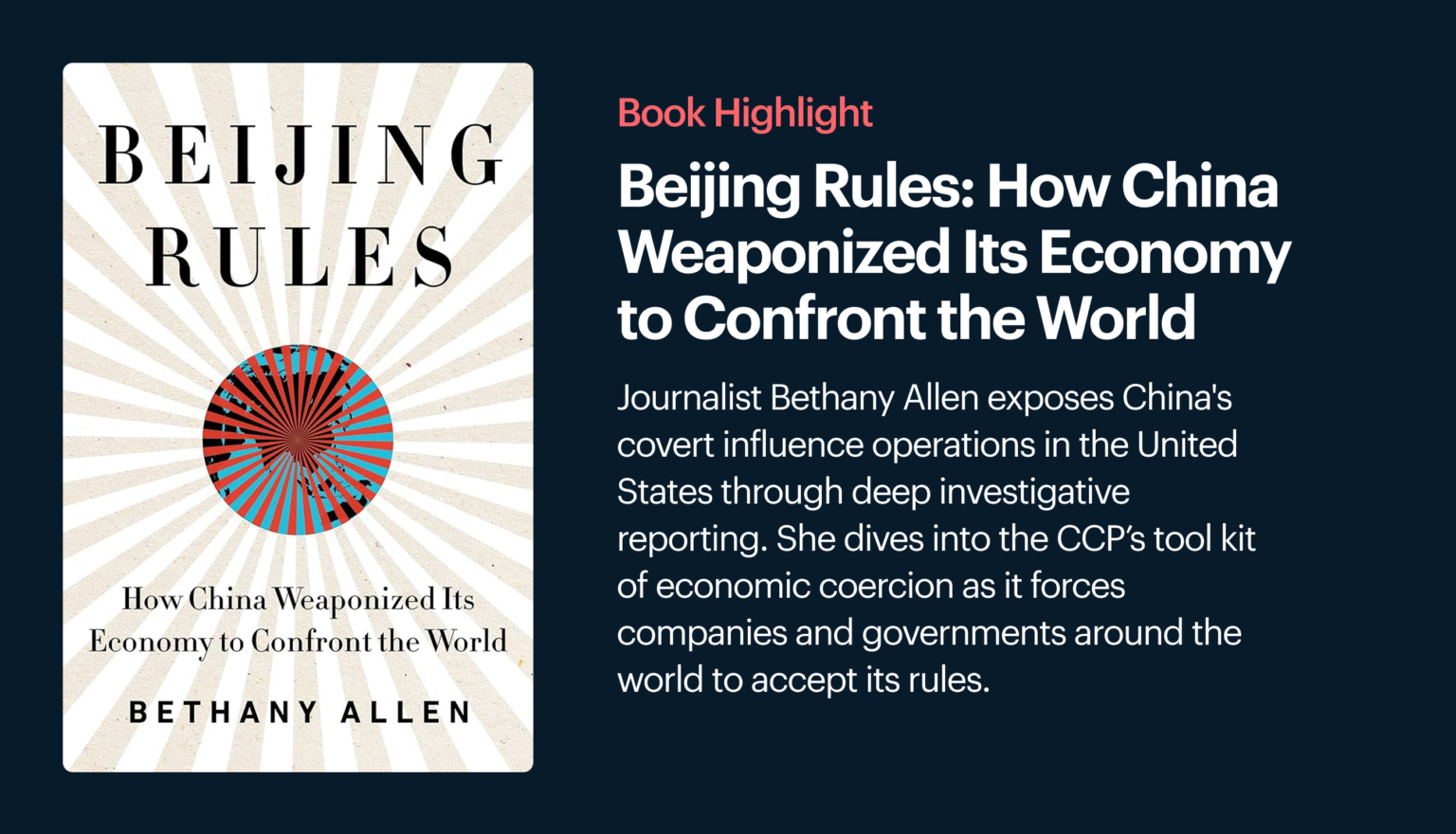
Beijing Rules
Allen makes visible the operating system that produces the evasion patterns described in Parts II and IV. The transshipping networks, the shell companies, the offshore importers of record with no U.S. nexus — these are features of a state-shaped trade ecosystem in which opacity, leverage, and offshore structures can serve national industrial objectives.
Why read: It reveals the state logic behind patterns that otherwise look like scattered, unrelated fraud.
Study Questions
- When harm from non-market competition can become entrenched before enforcement is complete, what operational changes—such as staffing, triage, interagency ownership, interim measures, or public accountability—would allow the government to respond more quickly while preserving due process?
Check your thinking
Open-ended — synthesize widely. Threads worth pulling
- Start from the structural problem: enforcement runs on a slower clock than the schemes it polices, so harm entrenches before a case concludes (solar: 2012 → 2023).
- The core tension is speed versus due process — the aim is to compress the timeline, not skip the rights.
- The levers the question names — triage, interagency ownership, staffing, interim measures, public accountability — are a starting palette; design an actual faster system from them.
- Borrow from other domains: how do national security, financial regulation, or antitrust act before harm becomes irreversible while preserving process — and what transfers?
- Follow the incentives: what resourcing, ownership, and interim authority would actually change behavior, and where is provisional action legitimate?
There is no single right answer — propose concrete mechanisms and defend the trade-offs.
- What does the term “non-market economy” explain about China’s economic system and trade behavior that broader labels such as “competitor” or “adversary” do not?
Check your thinking
A strong answer would address
- “Non-market economy” names the cause: China’s outcomes reflect a state-directed industrial strategy — subsidies, cheap credit, industrial coordination, forced scale, and long-term policy support (Made in China 2025) — not private firms succeeding in a neutral market.
- “Competitor” or “adversary” describe a posture or relationship; “non-market economy” describes how the system actually operates.
- That operating model is exactly what defeats enforcement tools built for ordinary market disputes — it can reorganize, absorb losses, and reroute (origin engineering through Cambodia, Malaysia, Thailand, and Vietnam) because the state, not the market, is directing it.
- So the label is analytically useful: it identifies the mechanism behind the harm (distorted prices, stranded investment, lost capacity), where the broader labels only name the stance.
Part VI: What to Fix
Reform means rebuilding what decades unraveled: a verification system weakened over fifty years and an enforcement architecture never designed for modern trade fraud. No single bill closes that gap. Reform must advance on several fronts at once.
De minimis shows both the possibility and the limits. The $800 duty-free channel fueled a decade of Chinese platform growth at the expense of U.S. importers, manufacturers, and logistics providers. Closing it — suspended by executive action in 2025, with permanent statutory repeal enacted in 2025 and effective July 1, 2027 — required executive action, congressional action, and political will. But the malign actors did not leave. Stripped of that cover and now facing Section 301 and Section 232 tariffs, they have more reason to falsify paperwork — shifting volume into transshipment, undervaluation, misclassification, and smuggling unless enforcement shifts with it.
The Executive Order to Strengthen Customs Enforcement, signed by President Trump on June 3, 2026, treats customs fraud as a national-level risk, not merely a revenue issue. The EO starts the work; implementation and legislation make it durable. That agenda works on three fronts — prevent, expose, and enforce — held together by a coordinating mandate.
The Architecture of Effective Trade Enforcement
Coordination and Accountability
The organizing mandate is disciplined execution. The problem is not simply a lack of enforcement tools; it is fragmented responsibility, inconsistent escalation, constrained capacity, and limited measurement of outcomes. CBP administers and enforces customs laws, HSI investigates criminal schemes, and DOJ brings civil and criminal cases—but the system has too often operated without a common mandate or clear measures of success.
The EO begins to provide that mandate. It directs DHS to implement broad customs reforms, requires DHS and the Attorney General to prioritize serious import violations, and establishes presidential oversight of implementation and results. It also directs DHS, in consultation with OMB and other agencies, to recommend legislation to strengthen the regime. The EO does not endorse specific bills, but its architecture closely overlaps with reforms already before Congress. EnforcementNOW views those proposals as vehicles to codify, extend, or complete that architecture. Progress can begin without a new statute, but lasting success will require sustained executive direction, adequate resources, clear interagency responsibility, and measurable outcomes.
Close Loopholes
The principle is enforceable responsibility: every party using the customs system should be identifiable, reachable, and financially responsible. The EO addresses paper-thin importer structures by tightening importer eligibility; requiring stronger bonding or tangible domestic assets; establishing good-standing requirements; cleaning up the importer registry; expanding recurrent vetting; and imposing heightened requirements on foreign importers.
Legislation would make key reforms durable and address pathways the EO does not reach. The SAFE Act would ensure that importers of record are verifiable, accountable, and financially reachable in the United States. The first-sale rule can permit duties to be calculated using an earlier, lower transaction value rather than the final price paid by the U.S. buyer; the Last Sale Valuation Act would close that valuation gap.
Enhance Transparency
The principle is visibility—first for enforcement, then for the market. The EO strengthens the information funnel into CBP by requiring disclosure of importer ownership, beneficial ownership, affiliations, foreign business identifiers, supply-chain and production information, and documents submitted to foreign customs before export. This allows CBP to identify who is behind an import, understand where and how the goods were produced, and compare the foreign export record with the U.S. entry. The EO also requires periodic review of confidentiality claims and annual enforcement-transparency reports.
Legislation would extend that visibility into the market. The Manifest Modernization Act would make cargo-manifest information available for air, truck, and rail, as it already is for ocean freight. Complementary country-of-origin proposals would give consumers, competitors, and enforcement agencies greater visibility into where products are actually made, whether sold online, at retail, or in sensitive sectors such as agriculture and pharmaceuticals.
Strengthen Enforcement
The principle is consequence: information matters only if it leads to timely investigations, meaningful penalties, and the removal of unlawful goods from U.S. commerce. The EO strengthens the administrative enforcement funnel by increasing audits; enforcing claims against customs bonds; holding brokers accountable; prioritizing forced-labor, misclassification, undervaluation, and illegal-transshipment cases, including EAPA investigations; establishing a minimum mitigated penalty of 50 percent of the assessed penalty; eliminating mitigation for repeat offenders; and streamlining seizure and disposal.
Legislation would add permanent institutional and private enforcement capacity. The PAIL Act would place a dedicated DOJ trade-crime task force into permanent law—the Eliot Ness model: specialists focused on one mission, rather than prosecutors assembled episodically. The Fighting Trade Cheats Act would strengthen penalties and allow injured industries to pursue trade violators directly. Leveling the Playing Field 2.0 would strengthen responses to AD/CVD circumvention and evasion. The Destruction of Hazardous Imports Act would authorize the destruction of FDA-regulated imports that present a significant public-health risk.
An order starts it. Law makes it last.
Executive Order 14411, Strengthening Customs Enforcement (June 3, 2026), opens all three fronts against trade crime — prevent, expose, enforce.
Last Sale Valuation Act — closes the valuation gap
Country-of-Origin Disclosure Bills — origin at point of sale
Fighting Trade Cheats Act — injured firms can sue
Leveling the Playing Field 2.0 — faster AD/CVD relief
Destruction of Hazardous Imports Act — destroy refused goods
A continuously updated list of legislation supporting each category is maintained at enforcementnow.com/petition-for-change.
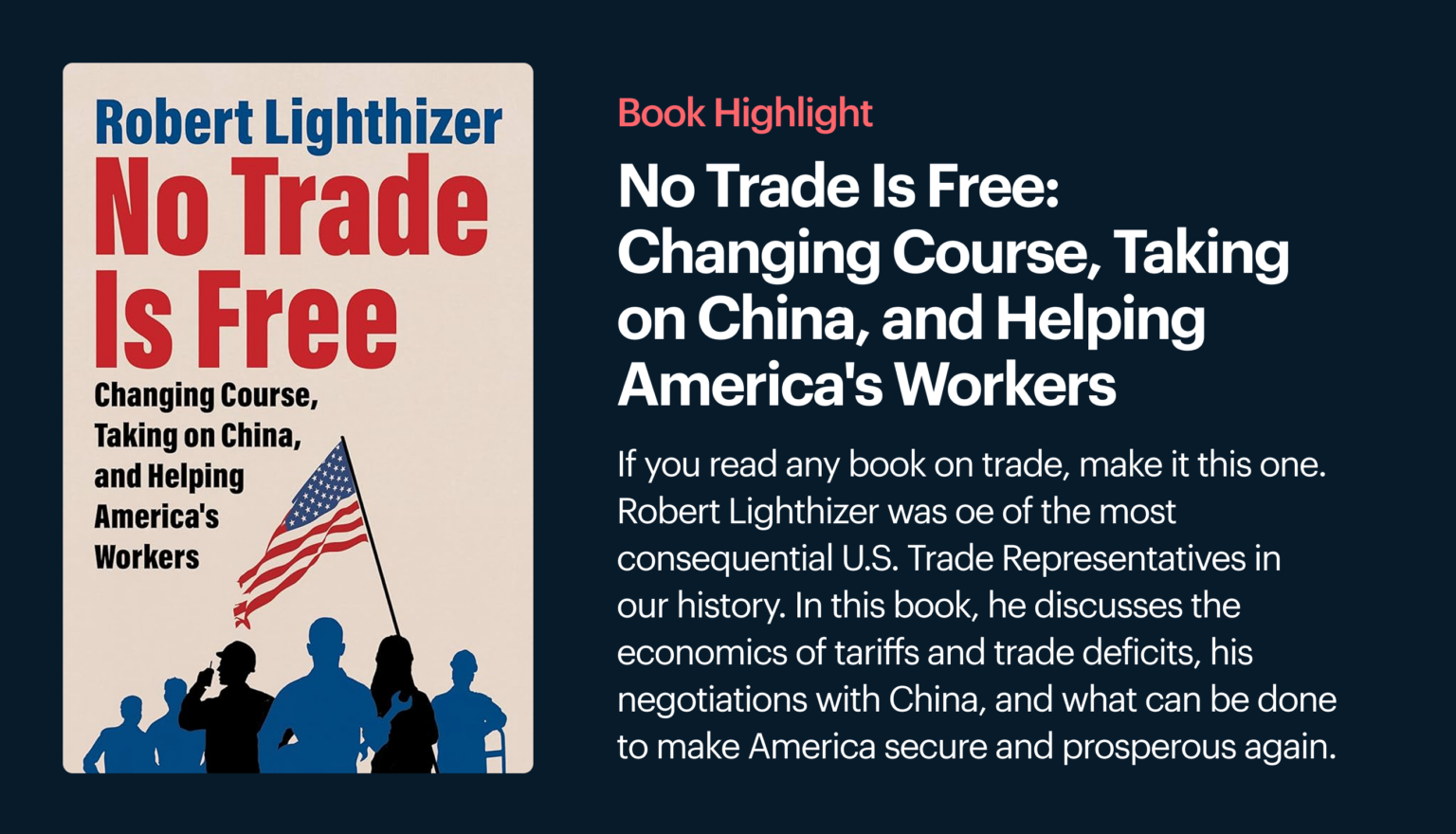
No Trade Is Free
Lighthizer was USTR under the first Trump administration and the architect of the 2018 Section 301 tariffs. No Trade Is Free is part memoir, part indictment of the post-WWII free-trade consensus, and part operating manual for the reform agenda this guide describes.
Why read: Lighthizer makes the case that tariffs without enforcement are policy theater — exactly the argument this guide is built on. His chapters on AD/CVD evasion, transshipment, and the structural weaknesses of the WTO valuation system map directly onto the reforms in this Part.
Study Questions
- How does each of the four reform categories reduce the incidence of violations, increase the likelihood that violations are detected, and ensure that consequences are imposed promptly?
Check your thinking
A strong answer would address
- Coordination & Accountability (the mandate) — “disciplined execution”: fixes fragmented responsibility with a common mandate, prioritization of serious violations, oversight, and measurable outcomes, so the other three fronts actually execute.
- Close Loopholes (Prevent) — reduces the incidence of violations by making every party identifiable, reachable, and financially responsible (importer eligibility, bonding or assets, SAFE Act, Last Sale Valuation).
- Enhance Transparency (Expose) — increases detection through disclosure of ownership, origin, and the foreign export record (Manifest Modernization, country-of-origin).
- Strengthen Enforcement (Enforce) — ensures prompt consequences: timely investigations, meaningful penalties (the penalty floor), removal of goods, and permanent capacity (PAIL’s dedicated task force).
- The through-line: loopholes → incidence, transparency → detection, enforcement → prompt consequences — held together by coordination.
- Which of the three legislative reform categories is likely to be the most difficult to advance—and why?
Check your thinking
A strong answer would address
- First, name the three legislative categories: Close Loopholes, Enhance Transparency, Strengthen Enforcement (Coordination & Accountability is the EO-led coordinating mandate, not a legislative category).
- This is a judgment call — a strong answer makes a defensible pick and justifies it from the text, rather than just naming one.
- Reasoning cues the text supports: Close Loopholes (SAFE Act / importer-of-record accountability) confronts the offshore/NRI actor and those who profit from paper-thin structures — the hardest problem the guide flags; Transparency asks businesses to disclose ownership and origin they would rather keep private; Strengthen Enforcement (PAIL, private rights of action) requires durable resources and institutional commitment.
- The point is the justification — tying difficulty to whose interests are threatened or what new capacity or disclosure is required.
- Which competing interests make stronger trade enforcement difficult to enact? How should policymakers weigh the costs of implementation against the costs borne by domestic producers, workers, consumers, and the government when trade laws are not effectively enforced?
Check your thinking
Open-ended — synthesize widely. Threads worth pulling
- The multinational stake (the entry lever): firms invested in the status-quo supply chain — where restructuring costs money and carries risk — and holding sunk capital in locations enforcement now disfavors. Then push past it.
- The political economy: concentrated beneficiaries with intense interests routinely beat diffuse public costs — why the status quo is structurally hard to dislodge, regardless of the merits.
- What trade policy is even for (the Cass frame): a system optimized for consumption and corporate efficiency versus one that values productive capacity, industrial resilience, and the dignity of work — who bears the cost, and who decides?
- Time horizons and reversibility: enforcement’s costs are largely transitional and fall on the system’s users; non-enforcement’s costs are cumulative and can be permanent — a lost industry does not come back.
- Rule of law as its own stake: what unenforced law does to the legitimacy of the whole system, and to the firms that play straight.
There is no single right answer — the aim is a rigorous, synthetic case that draws on your own grasp of globalization, industrial policy, and national resilience.
Closing
The American kitchen cabinet industry employs 250,000 people. It produces roughly $14 billion in gross output annually. Ninety-five percent of its companies are family-owned. Forty percent of its workforce lives in rural communities and underserved blue-collar towns — in Alabama, Indiana, Pennsylvania, North Carolina, Virginia, Washington, South Dakota, and Georgia.
In March 2019, 50 of these companies filed antidumping and countervailing duty petitions against wooden cabinet imports from China, which had captured $1.7 billion of the U.S. market. In April 2020, the Department of Commerce imposed AD/CVD duties averaging 59 percent. The industry had won.
The relief lasted months. By late 2020, the same cabinets were moving through Malaysia, Vietnam, Cambodia, Thailand, Indonesia, Mexico, and the Philippines. The Kitchen Cabinet Manufacturers Association filed allegation after allegation. CBP found, repeatedly, that Chinese cabinets were being relabeled in third countries and shipped to U.S. ports. The transshipment continued. By 2024, Southeast Asia and Mexico accounted for two-thirds of cabinet imports, and the cabinet trade deficit had doubled from where it stood before the duties.
The legal victories did not stop the bleeding. The plants kept closing. MasterBrand in Alabama: 750 workers across two waves. Solid Wood in Pennsylvania, 2020. Tru Cabinetry in Alabama, 2022. The Cabinetworks Group, two plants in 2024 — hundreds of jobs in Pennsylvania, 350 in Texas. Dura Supreme in North Carolina, all 74 employees in January 2025. UltraCraft in North Carolina, 200 jobs in September 2025. American Woodmark in Virginia, 131 jobs. Each closing was more than a facility. It was a payroll, a supplier base, a lunch counter, a school fundraiser, a mortgage payment, a family's plan. Each plant anchored a community. Together, they were a national story. Most of the country never heard about it.
This is what enforcement failure looks like when you watch it for six years. The industry did everything the system asked. It organized. It filed petitions. It won the legal victory. And it kept losing — not in court, but at the border, where legal victory never became real protection.
Cabinetry is only one chapter. The same story is being told by wire hanger manufacturers in Alabama, cast iron pipe foundries in North Carolina, aluminum extruders in Texas, rolled copper producers in New York, auto parts assemblers in Illinois, and Gulf shrimp producers on the Louisiana coast. Different products. Different regions. Same pattern.
These are not abstract policy constituencies. They are the parts of the American economy that furnish homes, build infrastructure, assemble vehicles, and feed the nation. The system was not defeated overnight. It was unraveled by American choices, over decades and in plain sight. It can be rebuilt, but not on the old timetable.
Our commitment to rebuild American industry requires that trade enforcement no longer be treated as a secondary function. The Executive Branch, Congress, and agency leadership must make it a national mandate in practice, with the authority, resources, urgency, and transparent measures of progress required to carry it out.
American industry is not asking for protection from competition. It is asking for the laws of the United States to be enforced.
Editable working copy · derived from americanmoment.org/study-guides/tradecrime · videos embedded live · flow diagram embedded from your project file · all other images are labeled slots awaiting the original files.